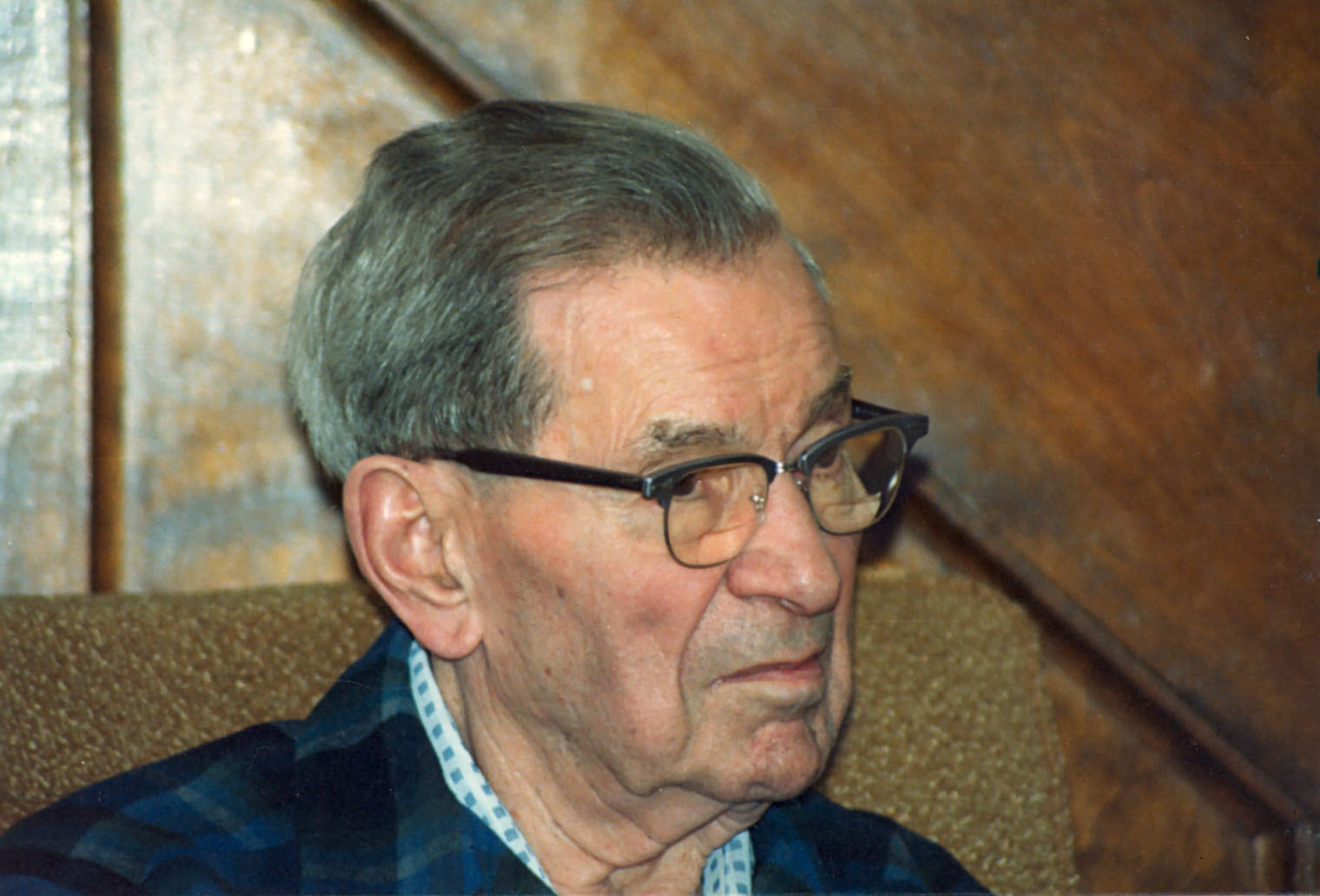
Allan R. Day
The Allan R. Day Award
Written by Madeleine Joullie during the year Allan passed (1989)
Professor Allan R. Day, the man after whom this lectureship is named, died on April 22, 1989. His death was a great loss to the many people upon whose lives he had such an enormous influence, and always for the better. Those who knew Allan well are aware of his dislike for praise and long-winded remarks — he was above all a very modest man.
Allan was born in Bluffton, Ohio, on June 5, 1899. After earning an A.B. degree from Bluffton College in 1921, he relocated to the Philadelphia area and began teaching chemistry and physics at Jenkintown High School. As his focus on chemistry sharpened, he started graduate studies at the University of Pennsylvania and took on a teaching assistantship in chemistry in 1924. Upon receiving his master of science degree in 1925, he resigned from Jenkintown High School to devote his full energies to teaching and doctoral studies at Penn.
The university recognized his teaching and research potential early, offering him an instructorship in 1926 — a year before he was awarded his Ph.D. He rose from instructor to assistant professor in 1929, to associate professor in 1948, and to full professorship in 1952.
Allan's research interests ranged from heterogeneous catalysis, cumulene dianion chemistry, and organic reaction mechanisms, to organic synthesis, medicinal chemistry, and the chemistry of nitrogen heterocyclic systems. To many, his name is synonymous with the chemistry of imidazole derivatives; he co-authored the chapter "Imidazoles and Condensed Imidazoles" for Elderfield's series on Heterocyclic Compounds. In collaboration with his friend and long-time colleague Professor John G. Miller, Allan and his students undertook a broad-range systematic study of the ammonolysis and aminolysis of carboxylate esters — work now cited in every major textbook on organic reaction mechanisms.
Day supervised the Ph.D. research of no fewer than 110 candidates, emphasizing independence, objectivity, and integrity. Among his best-known students are Professor Negishi and Professor Ed Arnett, along with many who became research directors in industry. He also maintained substantial contact with undergraduate teaching, and graduating classes repeatedly selected him as one of the most inspiring teachers at Penn — among those he influenced as an undergraduate was Dr. Roy Vagelos, later president of Merck Sharp & Dohme Research Laboratories.
Allan was a pioneer in introducing electronic mechanisms into the undergraduate curriculum, a change that met considerable resistance at the time but proved instrumental in inspiring students. His lecture notes formed the basis for the textbook Organic Chemistry, co-authored with Madeleine Joullie, one of his former graduate students. He also authored textbooks on Inorganic Qualitative Chemical Analysis and Electronic Mechanisms of Organic Reactions, and served as a consultant to several regional scientific companies.
An active participant in professional society affairs, Day served as chairman of the Philadelphia Section of the American Chemical Society, was a member of its Board of Directors, and represented it on the national Council. He was a founding member and chairman of the Philadelphia Organic Chemists' Club. He was also a member of the American Association for the Advancement of Science, the New York Academy of Sciences, Sigma Xi, Alpha Chi Sigma, and Phi Lambda Upsilon.
Outside chemistry, Allan was an accomplished violinist who played often with chamber music groups or with his wife Mae, composed songs (some used in Broadway musicals), and was an avid tennis player nearly to the end of his life.
Allan Russell Day — Degrees
- A.B. — 1921, Bluffton College
- M.S. — 1925, University of Pennsylvania
- Ph.D. — 1927, University of Pennsylvania
University of Pennsylvania
- 1924–1926 — Assistant Professor of Chemistry
- 1926–1929 — Instructor in Chemistry
- 1929–1951 — Associate Professor of Chemistry
- 1952–1968 — Professor of Chemistry
- 1968–1989 — Professor Emeritus